- Phone: +91 94298 24851
- Email: abhyasikamandal@gmail.com



Every seed begins with a dream; to one day grow into a tree. But only when the seed develops roots and strengthens its trunk does it find the stability to weather storms. In the journey of social leadership, this trunk represents maturity, resilience, and wisdom.
At this stage, leadership is not about proving your worth anymore, it is about providing for others. Just like a tree does not grow for itself, a true leader's purpose expands beyond self-interest. The tree stands tall not because it wants to be seen, but because it wants to hold, protect, and sustain.
A mature leader understands this deeply. Leadership is not about commanding authority; it is about carrying responsibility.
A tree gives shade even to the woodcutter who sharpens his axe under it. This is the true test of maturity; compassion even when not reciprocated.
In leadership too, impact is not measured by how many follow you, but by how many feel safe around you. A good leader creates safe spaces where people can fail without fear, share without judgment, and grow without hesitation.
Think of Mother Teresa, who built spaces where the unwanted and abandoned could find dignity. Or Dr. Verghese Kurien, whose Amul movement didn't just bring milk to markets but created livelihoods for millions of farmers. These leaders did not chase personal glory. They built shelters of trust and opportunity for others.
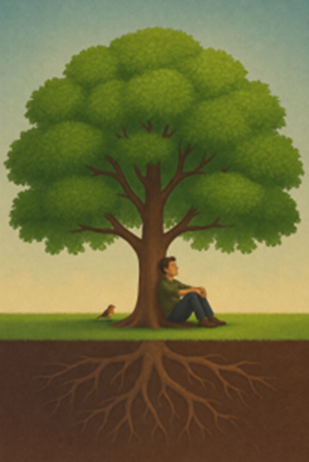
A true leader acts not for applause, but because it is their dharma to give shade where it is most needed.
Many mistake "status" for "impact". But positions, titles, and applause fade. What remains is service.
Nelson Mandela, after years in prison, had the option to hold grudges. Instead, he chose reconciliation and service, healing a divided nation. Closer to home, APJ Abdul Kalam lived a life of simplicity even while being the President of India. He did not chase luxuries — his legacy rests in his service to science, students, and education.
A tree does not ask, "Who deserves my fruit?" It simply gives. Similarly, social leadership matures when service rises above the craving for recognition.
We often hear organizations praise efficiency; doing things faster, cheaper, with less waste. But social leadership raises a deeper question: Are we doing the right things? That is effectiveness.
A hospital may be highly efficient in treating patients, but if it forgets compassion, it loses effectiveness. A business may achieve profits efficiently, but if it harms the environment a lot, its effectiveness is questionable.
When I had just started my practice as a young surgeon in my small hospital, one of my neighbours came to me with a wrist fracture. I got the X-rays done and explained that it was a very minor and simple surgery. But they hesitated and said, "We only came to show you because you are nearby. For surgery, we will go to our regular surgeon in another area."
It was a difficult moment for me. Imagine the feeling! Not being trusted even for a basic surgery. Yet, fulfilling both my duty as a doctor and as a neighbour, I did what I could. I gave them pain relief treatment and even arranged their travel to the other hospital free of charge.
Years later, the same neighbour came back to me, not for wrist, but for a knee replacement. I smiled, remembering that old day. They told me, "Back then you were new, but now for something as crucial as knee replacement, we trust only you. We still remember your gesture of goodwill."
That moment taught me that stability in leadership takes time and patience. Trust does not grow overnight. Like a tree, you don't need to prove yourself to everyone immediately. You just need to keep working, quietly and consistently. Over time, people will remember the shade you offered, not the height of your claims.
A leader, like a tree, must know when to bend, when to stand tall, and when to step aside.
This balance is what makes leadership sustainable. A tree knows when to grow upward, when to spread outward, and when to quietly shed its leaves for renewal. Leaders too must adapt their position according to the season of their team.
The Mahabharata is not just a story of a war; it is a story of an inner battlefield. Krishna and Arjun are not outside; they live within us.
In every decision, we face two voices. Arjun, filled with doubt, hesitation, and fear, asks: "Can I do this? Should I step back?" Krishna, the voice of clarity and dharma within, replies: "Stand up and do your duty."
Social leadership matures when we learn to listen to the Krishna within us. That inner voice reminds us:
The Gita's wisdom whispers daily: "You are not the owner of the results, only of your actions." Like the tree, keep giving without counting.
Swami Vivekananda echoed this when he said, "They alone live who live for others; the rest are more dead than alive."
The lesson is simple: the leader's battlefield is not outside — it is inside. And victory comes when we let Krishna's wisdom guide Arjun's courage within us.
The impact of social leadership is not in the noise it makes but in the shelter it creates. A tree does not demand attention, yet it sustains countless lives silently.
Here are some thoughts to carry with you:
Up next: The Legacy of Social Leadership — the last part of our journey, where we explore how true leadership leaves behind fruits that nourish others and seeds that inspire new beginnings.
* * *