Abstract
This writes up note explores the conceptual and philosophical contradiction between the notions of
“Human as Resource” and
“Human as Source” in the
Indian context.
While the former originates in industrial-capitalist frameworks that prioritize productivity and economic gain,
the latter draws upon India’s spiritual and humanistic traditions emphasizing moral, intellectual, and creative potential.
By integrating perspectives from Indian thinkers such as Mahatma Gandhi and Swami Vivekananda, and from ancient scriptures like the Bhagavad Gita and the Upanishads, this paper argues for a paradigm shift from resource-based management to source-based human development.
1. Introduction
The concept of human beings as
resources emerged during the industrial revolution, positioning people as factors of production to be optimized for efficiency. In contrast, Indian thought envisions humans as
sources of innovation, compassion, knowledge and wisdom. This dichotomy remains evident in modern India, where corporate frameworks often conflict with cultural and ethical traditions.
2. Human as Resource: The Utilitarian View
Viewing humans as
resources treats them as tools or machine for achieving organizational objectives. This approach values performance, measurable outcomes, and competitiveness. It often reduces individuals to data points within systems, leading to alienation and emotional fatigue. The Indian corporate sector largely follows this model, emphasizing productivity over personal growth.
3. Human as Source: The Humanistic Vision
The Human as
Source approach, deeply rooted in Indian philosophy, regards people as the origin of all creativity and values. Mahatma Gandhi observed, “A nation’s culture resides in the hearts and in the soul of its people.” Similarly,
Swami Vivekananda emphasized, “The best way to serve God is by serving man.”
The Bhagavad Gita reinforces this in
“योग: कर्मसु कौशलम” — “Yoga is excellence in action” (2.50). The Upanishadic principle
तत्त्वमसि (“Thou art That”) reveals the divine essence within every individual, suggesting that human potential is boundless.
4. The Indian Contradiction
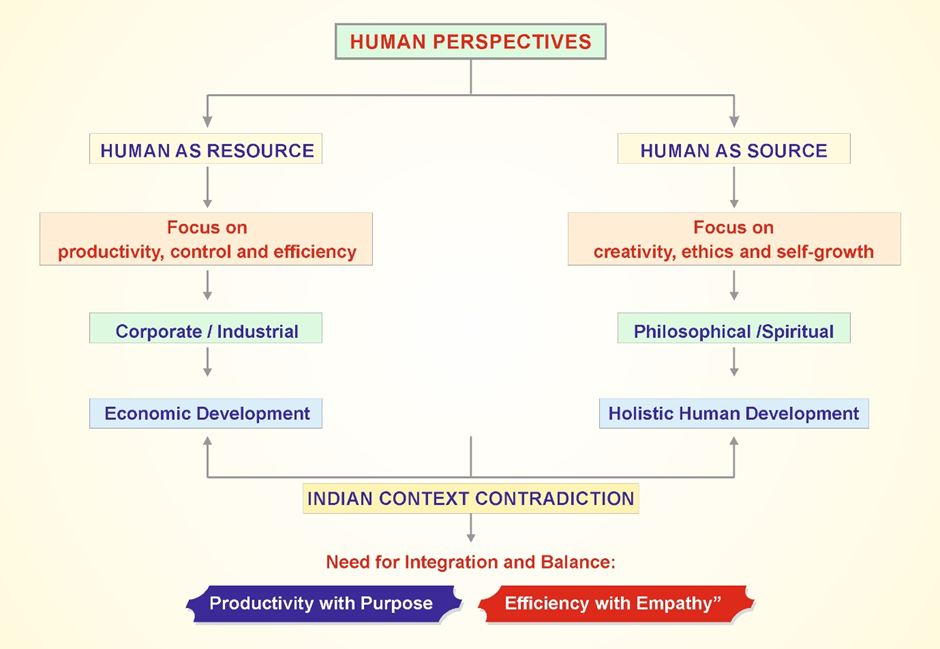
India faces a paradox: Its economic system promotes efficiency through human resource management, while its cultural ethos values holistic development through human realization. The challenge lies in
integrating these perspectives — using economic progress as a means to human well-being, not an end in itself.
5. Indian scriptural wisdom is a deeply philosophical and it has a cultural foundation. Many ancient Indian texts — the Vedas, Upanishads, Bhagavad Gita, Arthashastra, and Thirukkural — emphasize the
primacy of human consciousness, knowledge, and action over material wealth.
Here are
powerful quotes (with context and interpretations):
🕉️ 1. Rig Veda (10.191.2)
“Sangachhadhwam samvadadhwam, sam vo manāmsi jānatām.”
– “Move together, speak together, let your minds be in harmony.”
Meaning:
The Rig Veda highlights collective human intention and cooperation as the true creative force — not material resources.
🕉️ 2. Upanishads – Chhandogya Upanishad (8.7.1)
“Tat tvam asi” — “Thou art That.”
Meaning:
Each individual is not a resource but an embodiment of the ultimate reality (Brahman). Human potential is divine and infinite. To reinforce the idea that humans are the source of all creation and consciousness.
🕉️3. Bhagavad Gita (2.47)
“Karmanye vadhikaraste, ma phaleshu kadachana.”
– “You have the right to work, but not to the fruits of your actions.”
Meaning:
The focus is on human action and purpose, not material gain. The human will and intent give meaning to all resources. “The Human Role in Value Creation.”
🕉️ 4. Kautilya’s Arthashastra (Book I, Chapter 7)
“Of all the resources of the state, the human being is the greatest.”
Meaning:
Kautilya recognized human intellect and leadership as the ultimate asset — above land, wealth, or arms. “Human as the Source”.
🕉️ 5. Thirukkural (Chapter 45, Verse 447)
“Men are the real wealth of a nation, more than its lands and treasures.”
Meaning:
The Tamil classic Thirukkural identifies human virtue, wisdom, and capability as a society’s true capital. To emphasize that human development precedes material prosperity.
🕉️ 6. Mundaka Upanishad (1.1.9)
“Parīkṣya lokān karma-chitān brāhmano nirvedam āyāt.”
– “Having examined the world built by action, the wise one turns to the source.”
Meaning:
Material achievements are transient; the source of creation and knowledge lies within human consciousness. — contrasting “Resource vs. Source.”
🕉️ 7. Bhagavad Gita (4.13)
“Chaturvarnyam maya srishtam, guna karma vibhagashah.”
– “Human roles are created based on qualities and actions.”
Meaning:
The Gita emphasizes guna (innate qualities) and karma (action), highlighting that human nature and creativity define productivity — not external resources.
🕉️ 8. Manusmriti (7.144)
“The root of all wealth is labor; the root of all dharma is truth.”
Meaning:55
Human effort (karma) is the foundation of all prosperity. Source of economic and ethical value.
6. Conclusion:
Bridging the gap between
Human as Resource and Human as Source requires reimagining management practices through an ethical and spiritual lens. True national progress depends not merely on skilled manpower but on
enlightened individuals capable of compassion, creativity, and moral leadership. Thus, India’s future development should harmonize material success with inner fulfilment — transforming human resource management into
human enrichment management.
📊 Graphical Conceptual Representation
Here’s a simple visual model:
***