Article 1: The Start of Social Leadership: It Begins with a Seed

Have you ever felt a small urge from within to make things better? Maybe helping a friend study who needed support, making a park or tourist place cleaner, or giving company to elders in your neighbourhood. Sometimes it feels like a quiet restlessness, as if something in you wants to go beyond the ordinary. Other times, it feels like a happy pull at your heart when you think, “Maybe I can make a difference.”
That feeling is not just emotion; it is a spark. It is a possibility knocking at your door. It is the
seed of social leadership; waiting for you to plant it and see how far it can grow.
What is Social Leadership in a Nutshell?
At its core,
social leadership means leading with the intention of creating positive impact for others, not just for yourself. It does not matter whether you are heading a large team or just helping one person. If your decisions, actions, and voice are directed towards bettering society in some way, you are practicing social leadership.
It is different from conventional leadership, which is often about titles, positions, and authority. Social leadership is about
cause, contribution, and connection.
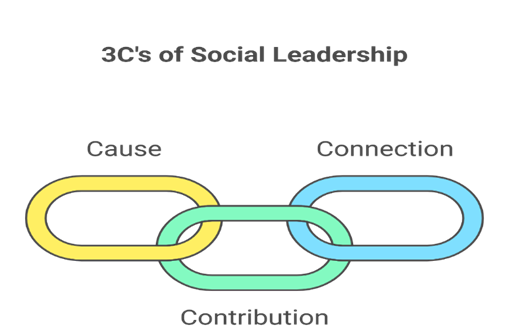
It begins when you find something bigger than yourself - a
cause to work for, a purpose that gives your energy direction. A cause does not have to be massive, like ending poverty or climate change; it can be as simple as helping students with resources or creating awareness about mental health. What matters is that it excites you and makes you want to show up consistently. Without a cause, leadership can easily become self-centred. With a cause, even the smallest action feels meaningful.
But social leadership does not stop at cause; it grows into
contribution. Contribution is the willingness to give time, effort, skills, or even just your presence to make life a little better for others. Then comes the
connection. Connection is the ability to bring people together, to create trust, and to build a shared journey. A true social leader does not walk alone; they spark movements by weaving together the strengths and hopes of many.
That is what turns an individual seed into a forest of impact.
The Seed of Social Leadership
Let us discuss with the idea of a seed for a moment.
In our lives, the seed is our
intention, the spark of a cause, a dream, or a responsibility we feel deeply about. Intention is not just wishful thinking; it is the answer to the question, “Why am I doing this?” It is the inner fire that gives direction to your actions.
Without intention, efforts feel scattered. With intention, even small acts carry meaning. For example, if your intention is to reduce food waste, every time you organize a leftover-food drive, it connects back to that seed. Intention gives clarity and keeps you going when distractions or doubts arise.

But a seed does not grow in thin air; it needs soil. For us, that soil is
self-awareness. Self-awareness means knowing yourself: your values, your strengths, your weaknesses, your personality, and your natural style of interacting with the world. You do not have to know everything about yourself on day one, but the more you discover, the richer your soil becomes.
Every day, take a pause and ask yourself three simple questions:
“Who am I?” (कौन हूँ मैं?)
“Why am I here?” (क्यों आया/आयी हूँ मैं?)
“Where do I want to go?” (कहाँ जाना है मुझे?)
These are not just questions; they are doors that open to your inner world. Our rishis and saints have reflected on them for centuries. The first question brings you closer to your true
identity, the second reminds you of your
purpose, and the third shows you your
direction.
When you sit with these thoughts daily, even for a few minutes, something changes. Life feels less rushed, more meaningful. Your struggles start making sense, and your journey feels guided. This simple practice, rooted in our Indian wisdom, can slowly bring peace, clarity, and even a touch of spiritual light in everyday living.
This is the first step to what I call as
Spirituality at Work – small, tiny practices in daily work life that make every task an act of service and kindness. We will discuss more about Spirituality @ Work in upcoming articles.
One simple framework to remember is the
four lenses of self-awareness:
1.
Values – What matters most to me? (e.g., honesty, compassion, transparency, etc)
2.
Strengths – What comes naturally to me? (e.g., organizing, speaking, designing, comforting people)
3.
Improvement Areas – Where do I struggle, and how can I improve? (e.g., patience, confidence, teamwork)
4.
Personality – How do I usually behave, decide, and relate to others? (e.g., am I more introverted or extroverted, do I prefer planning or flexibility, am I calm under pressure or easily stressed?)
When you know your personality along with your values and strengths, you can choose roles and causes that fit you better. For example, if you are naturally outgoing, you might enjoy leading awareness campaigns. If you are reflective and detail-oriented, you might design systems, posters, or strategies behind the scenes. Both are leadership. Both are important. Self-awareness simply helps you place your seed in the right soil so that it has the best chance to grow.

Does Social Leadership Mean Charity?
At this point, some of you might wonder: Does being a social leader mean giving up money, living only for charity, and forgetting your personal ambitions?
The answer is No. Social leadership is not about rejecting material success; it’s about
redefining success. Money matters. Without it, your ideas cannot survive for long. Think of it this way: a tree can only keep giving fruit if its roots are nourished. Similarly, your cause can only be sustained if you build it on a foundation that balances impact with financial strength.
In the beginning, you may ask for help to cover initial needs like space, materials, or setup. Many great initiatives began with donations, borrowed classrooms, or shared resources. But in the long run, operational costs will come in, and that’s where sustainability becomes crucial. If your model cannot support itself, even the noblest ideas may fade away.
Another part of sustainability is people. Remember, one of the Cs of social leadership is
connection, and team building is at the heart of it. In the early days, your team might be volunteers, working purely out of passion. But as your vision grows, if you want good team members to stay and give their best, you’ll need to pay them too. Passion may attract people, but fair compensation is needed to retain them.
That’s why I believe
money may not be the ultimate goal, but it is an important vehicle. It helps you fuel your cause, sustain your team, and expand your impact. Social leadership is not about charity that ends when funds run out; it’s
about creating models where meaning and money walk together, ensuring long-term change.
Footprints to Follow
When we think of leadership, we often imagine CEOs in sharp suits or politicians giving long speeches. But the 21st century demands a different kind of leader.
Take Dr. Devi Shetty’s story. His seed wasn’t to build one of the largest hospital chains in India. It was simply a question: Why should a child die of a heart condition just because their parents cannot pay? That burning desire became Narayana Hrudayalaya, which today performs thousands of affordable heart surgeries.
Or consider Shaheen Mistri, a college student, who noticed the inequality in classrooms. She began teaching children in Mumbai slums. That seed grew into Teach for India, a nationwide movement. These stories remind us: social leadership doesn’t start with power. It starts with
compassion meeting conviction.
The Seed of My Journey
I will be honest with you about my own path.
When I was in school, I always wanted to be an engineer. I loved numbers and the idea of building things. But one of my relatives suggested that, since I had scored well in my 12th, I should become a doctor. I obeyed their advice, even though it wasn’t my first choice. And today, I am an orthopaedic surgeon.
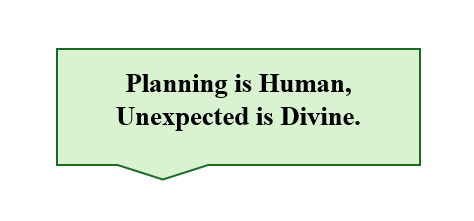
Looking back, I realize I didn’t force this journey, it was destiny guiding me. Sometimes, when you don’t know where to go, just pick a route. Destiny has a way of placing you exactly where you’re meant to be.
Interestingly, today I feel I am both a doctor and an engineer. Orthopaedic surgery requires the best of engineering skills: mechanical understanding of joints, civil-like precision in structural alignment, IT and robotics for advanced tools, and even electrical knowledge for equipment. And all of this comes together in operations where I often work with 0.5 mm and 0.5 mm precision. It’s a fascinating blend of science, skill, and responsibility.
But beyond the technical side, being a doctor has given me the privilege of caring for people. I get to see families walk away with relief, hope, and trust. And in these small moments, helping someone walk again, sitting with a worried family, celebrating a patient’s first steps after surgery, I see what social leadership really is.
It’s not always about grand speeches. Sometimes, it’s about doing your work with honesty, compassion, and consistency. Each of those acts is a seed of social leadership planted in someone’s life.
Your Leadership Mirror
Let’s pause here. I want you to reflect for yourself.
• What is one cause that you really care about? If you do not know yet, try to answer the questions below.
• Do you want to be remembered for your title or for the impact you created?
• If money was not an issue, what’s the first thing you would build or start to help others?
• When was the last time you saw something unfair and wished you could act? What stopped you?
Take five minutes. Write down your answers. You will be surprised by how much clarity emerges when you put your thoughts on paper.
The Road Ahead
A seed planted in the soil is still vulnerable. It can be washed away, eaten, or dried up. What protects it?
Roots.
In leadership, your values are your roots. They ground you, hold you firm in storms, and make sure your growth is sustainable. Without roots, even the tallest tree can collapse.
So, once you’ve planted your seed of intention, the next step is to strengthen your roots. In the next article of this series, we’ll go deeper into these roots, what they mean, how to grow them, and why they make the difference between a leader who lasts and one who falls.
For now, remember this: you already have the seed. Don’t wait for the perfect season. Plant it today.
The Ending Thought
I will leave you with these words:
“Don’t judge each day by the harvest you reap but by the seeds that you plant.” – Robert Louis Stevenson
Maybe your seed is small today. But who knows? Tomorrow, it could be the forest that shelters countless lives.
***